Blue Island Lead Service Line Replacement Program
Is lead pipe replacement free in Blue Island?
We haven't confirmed a free program in Blue Island yet. Ask Blue Island whether it covers the private side, offers a cost share, or uses federal money for low-income owners. Blue Island reported 778 lead and galvanized service lines to EPA (Q3 2026), which federal rules generally require it to replace by December 31, 2037.
Blue Island serves about 21,494 people and reported 778 lead service lines that must be replaced, out of 5,433 lines, in EPA's Q3 2026 inventory, plus 4,540 lines of unknown material. Here's who pays to replace yours, what it costs, and how to sign up.
No local program confirmed yet
We haven't confirmed the terms of a homeowner replacement program for Blue Island. In Illinois, each utility sets its own policy, so call before you hire a contractor.
Five questions to ask Blue Island (708-597-8603)
- Is my service line listed as lead, galvanized or unknown, and on which side?
- When is my street scheduled for replacement?
- Do you pay for the private side, or offer a cost share, loan or low-income grant?
- If I hire my own plumber now, will you reimburse me or replace the public side at the same time?
- Do you provide a free filter or lead test while I wait?
Know the program terms? Tell us and we'll add them after checking the source.
Lead lines in Blue Island
The most recent 90th-percentile lead result EPA lists for this system is 10 parts per billion (2025-07 to 2025-12). Under the new federal rule, the action level drops to 10 ppb in 2027. Galvanized lines count if they ever sat downstream of a lead pipe, because they can hold lead particles. Unknown lines must be identified by the utility, and many turn out to be lead.
How Blue Island compares: it ranks #473 of 7,556 U.S. water systems and #84 of 397 in Illinois for lead and galvanized lines. 14.3% of its service lines need replacing, compared with 23.8% across Illinois. See the national ranking.
Source: EPA SDWIS Service Line Inventory, Q3 2026 · Utility phone: 708-597-8603 · PWSID IL0310240
Blue Island lead service line map: check your address
Every water utility had to publish an inventory of its service lines, and most offer an address lookup map. Search for "Blue Island service line inventory" or call the utility at 708-597-8603 and ask for your address's status. The status will be lead, galvanized requiring replacement, non-lead or unknown. If it's unknown, you can usually check the pipe yourself and send the utility a photo.
The map will label your address lead, galvanized requiring replacement, non-lead or unknown. Unknown does not mean safe. What each status means and how to correct it.
Who pays in Illinois?
Illinois was one of the first states to require full replacement of every lead service line. Each water supply must file a final replacement plan by April 15, 2027, then replace a set share of its lead lines every year, on a timeline of 15 to 50 years depending on how many it has. A utility may bill the owner for the private side only if it is not using state or federal money for that work, and an owner can sign a waiver to decline private-side replacement. Illinois EPA lends to water systems and forgives part of the loan in lower-income communities, which is why many Illinois programs are free.
The law: Lead Service Line Replacement and Notification Act (415 ILCS 5/17.12). Mandatory? Yes. Illinois requires every community water supply to replace all lead service lines, and partial replacements have been banned since January 1, 2022. Funding: Illinois EPA Public Water Supply Loan Program (with principal forgiveness for disadvantaged communities).
Sources: news.wttw.com, agendadocs.downers.us
Nationwide, EPA's Lead and Copper Rule Improvements require most utilities to replace every lead and galvanized-requiring-replacement line by December 31, 2037, starting November 1, 2027. Utilities must mail a notice every year to each home with a lead, galvanized or unknown line. See the federal timeline.
Until your line is replaced
Showering and bathing are generally safe, but boiling does not remove lead. Use a filter certified to NSF/ANSI 53 for drinking, cooking and baby formula, use cold water only, and flush the tap after water sits. More on living with a lead line. If a crew offers to replace only one side, read why partial replacement is risky.
What would you pay?
Many utility loans are 0% (enter 0). Private loans run higher. Your real price depends on how far the house sits from the street, digging versus trenchless methods, permits and restoration. This is an estimate, not a quote.
Not covered, or can't wait?
Get up to 3 quotes from licensed plumbers who replace service lines in Blue Island.
Common questions
Is lead service line replacement free in Blue Island?
We haven't confirmed a free program in Blue Island yet. Ask Blue Island whether it covers the private side, offers a cost share, or uses federal money for low-income owners.
Is lead service line replacement mandatory in Blue Island?
Yes. Illinois requires every community water supply to replace all lead service lines, and partial replacements have been banned since January 1, 2022.
How much does it cost to replace a lead service line in Blue Island?
Most private-side replacements cost about $4,000 to $10,000, and long or difficult lines can run higher. Price depends on the distance from the street to your house, whether the contractor digs a trench or pulls the new pipe through (trenchless), permits, and restoring your lawn, sidewalk or basement wall. We haven't confirmed a local cost-share program for Blue Island, so ask the utility before you hire anyone; many programs only pay if the utility's own contractor does the work.
How do I know if my home has a lead service line?
Look up your address on Blue Island's service line inventory or check the letter it mailed you. You can also check the pipe where it enters your basement, usually near the meter: lead is dull gray, soft, and turns shiny silver when you scratch it with a key, and a magnet won't stick. Galvanized steel is gray too, but a magnet sticks to it. See our step-by-step guide.
What if I can't afford to replace my lead line?
Ask Blue Island about income-based help first; federal money often makes replacement free for low-income owners. Other options are utility payment plans, 0% city loans, state revolving fund programs, property tax assessments and home improvement loans. Our guide on paying for replacement lists them.
Who owns the water service line?
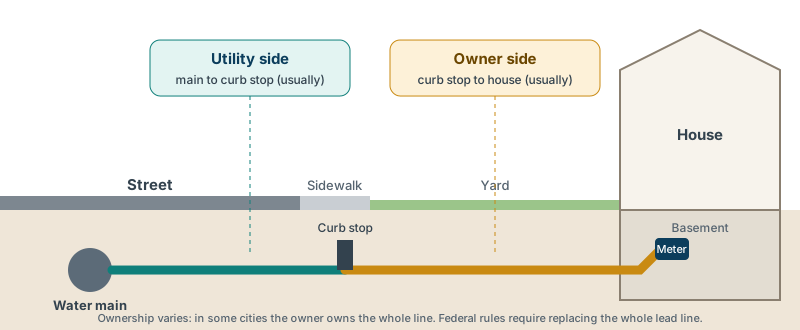
In most U.S. cities the utility owns the pipe from the water main to the curb stop or property line, and the property owner owns the rest, into the house. Some utilities, including Minneapolis and many in St. Louis County, treat the whole line as the owner's. Federal rules now require utilities to replace the whole lead line, not just their part.
Other water utilities in Cook County and across Illinois
Chicago ✓Cicero ✓Berwyn ✓Evanston ✓Oak Park ✓Skokie ✓South JacksonvilleGranite City (Illinois American Water) ✓River ForestMount VernonWest ChicagoSouth Chicago HeightsCarrolltonMelrose Park
All water systems in Cook County → · See every Illinois utility →
Something out of date? Report a change. We recheck program terms at least once a year.