Phoenix Lead Service Line Replacement Program
Is lead pipe replacement free in Phoenix?
Possibly. City of Phoenix is replacing lead lines, but hasn't published what owners pay. Phoenix Water began replacing service lines identified as lead or galvanized requiring replacement in 2025. City of Phoenix reported 506 lead and galvanized service lines to EPA (Q3 2026), which federal rules generally require it to replace by December 31, 2037.
City of Phoenix serves about 1,695,000 people and reported 0 lead and 506 galvanized service lines that must be replaced, out of 500,208 lines, in EPA's Q3 2026 inventory, plus 227,517 lines of unknown material. Here's who pays to replace yours, what it costs, and how to sign up.
City replacing both sides
Phoenix Water began replacing service lines identified as lead or galvanized requiring replacement in 2025. City contract documents describe replacing substandard lines on both the city side and the customer side of the meter, from the meter to the spigot. The city estimated the program at about $40 million and sought federal money for half. What owners pay, if anything, hasn't been published.
How to get it
- Look up your address on pipes.phoenix.gov, the city's service line site.
- If your line is listed for replacement, ask Phoenix Water Services when your area is scheduled.
- Confirm in writing whether the customer side is covered before hiring anyone.
Sources: phoenix.gov, kjzz.org
Lead lines in Phoenix
The most recent 90th-percentile lead result EPA lists for this system is 2.7 parts per billion (2022-01 to 2024-12). Under the new federal rule, the action level drops to 10 ppb in 2027. Galvanized lines count if they ever sat downstream of a lead pipe, because they can hold lead particles. Unknown lines must be identified by the utility, and many turn out to be lead.
How Phoenix compares: it ranks #652 of 7,556 U.S. water systems and #2 of 25 in Arizona for lead and galvanized lines. 0.10% of its service lines need replacing, compared with 0.2% across Arizona. See the national ranking.
Source: EPA SDWIS Service Line Inventory, Q3 2026 · Utility phone: 602-256-5658 · PWSID AZ0407025
Phoenix lead service line map: check your address
Every water utility had to publish an inventory of its service lines, and most offer an address lookup map. Start with City of Phoenix's official lead program page, which links to its lookup or explains how to get your line checked. The status will be lead, galvanized requiring replacement, non-lead or unknown. If it's unknown, you can usually check the pipe yourself and send the utility a photo.
The map will label your address lead, galvanized requiring replacement, non-lead or unknown. Unknown does not mean safe. What each status means and how to correct it.
Communities and ZIP codes served
ZIP codes: 85003, 85004, 85006, 85007, 85008, 85009, 85012, 85013, 85014, 85015, 85016, 85017, 85018, 85019, 85020, 85021, 85022, 85023, 85024, 85026, 85027, 85028, 85029, 85031, 85032, 85033, 85034, 85035, 85037, 85040, 85041, 85042, 85043, 85044, 85045, 85048, 85050, 85051, 85053, 85054
Who pays in Arizona?
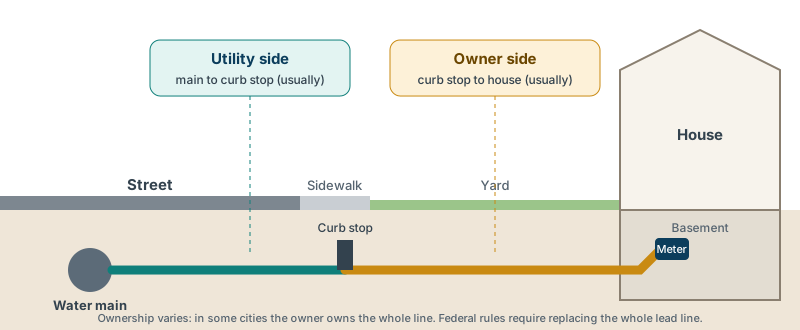
This state has no law we found that decides who pays for the private side of a lead service line, so each utility sets its own policy. Under the federal rule, utilities must replace every lead line and galvanized line that needs it within ten years of November 1, 2027, but the rule does not make utilities pay for the owner's side. Federal infrastructure money passed through the state revolving fund can pay for it, so many utilities offer free or discounted replacement, especially for low-income owners.
The law: Federal Lead and Copper Rule Improvements (40 CFR 141 Subpart I). Mandatory? No state owner mandate found; the federal rule requires most utilities to replace all lead and galvanized-requiring-replacement lines by 2037. Funding: State Drinking Water State Revolving Fund (federal lead service line money).
Sources: epa.gov
Nationwide, EPA's Lead and Copper Rule Improvements require most utilities to replace every lead and galvanized-requiring-replacement line by December 31, 2037, starting November 1, 2027. Utilities must mail a notice every year to each home with a lead, galvanized or unknown line. See the federal timeline.
Until your line is replaced
Showering and bathing are generally safe, but boiling does not remove lead. Use a filter certified to NSF/ANSI 53 for drinking, cooking and baby formula, use cold water only, and flush the tap after water sits. More on living with a lead line. If a crew offers to replace only one side, read why partial replacement is risky.
What would you pay?
Many utility loans are 0% (enter 0). Private loans run higher. Your real price depends on how far the house sits from the street, digging versus trenchless methods, permits and restoration. This is an estimate, not a quote.
Not covered, or can't wait?
Get up to 3 quotes from licensed plumbers who replace service lines in Phoenix.
Common questions
Is lead service line replacement free in Phoenix?
Possibly. City of Phoenix is replacing lead lines, but hasn't published what owners pay. Phoenix Water began replacing service lines identified as lead or galvanized requiring replacement in 2025.
Is lead service line replacement mandatory in Phoenix?
No state owner mandate found; the federal rule requires most utilities to replace all lead and galvanized-requiring-replacement lines by 2037.
How much does it cost to replace a lead service line in Phoenix?
Most private-side replacements cost about $4,000 to $10,000, and long or difficult lines can run higher. Price depends on the distance from the street to your house, whether the contractor digs a trench or pulls the new pipe through (trenchless), permits, and restoring your lawn, sidewalk or basement wall.
How do I know if my home has a lead service line?
Look up your address on City of Phoenix's service line inventory or check the letter it mailed you. You can also check the pipe where it enters your basement, usually near the meter: lead is dull gray, soft, and turns shiny silver when you scratch it with a key, and a magnet won't stick. Galvanized steel is gray too, but a magnet sticks to it. See our step-by-step guide.
What if I can't afford to replace my lead line?
Ask City of Phoenix about income-based help first; federal money often makes replacement free for low-income owners. Other options are utility payment plans, 0% city loans, state revolving fund programs, property tax assessments and home improvement loans. Our guide on paying for replacement lists them.
Who owns the water service line?
In most U.S. cities the utility owns the pipe from the water main to the curb stop or property line, and the property owner owns the rest, into the house. Some utilities, including Minneapolis and many in St. Louis County, treat the whole line as the owner's. Federal rules now require utilities to replace the whole lead line, not just their part.
Other water utilities across Arizona
Something out of date? Report a change. We recheck program terms at least once a year.